4
min read
Copying a brand that works never works
A case study on how Linear translated product strategy to brand identity
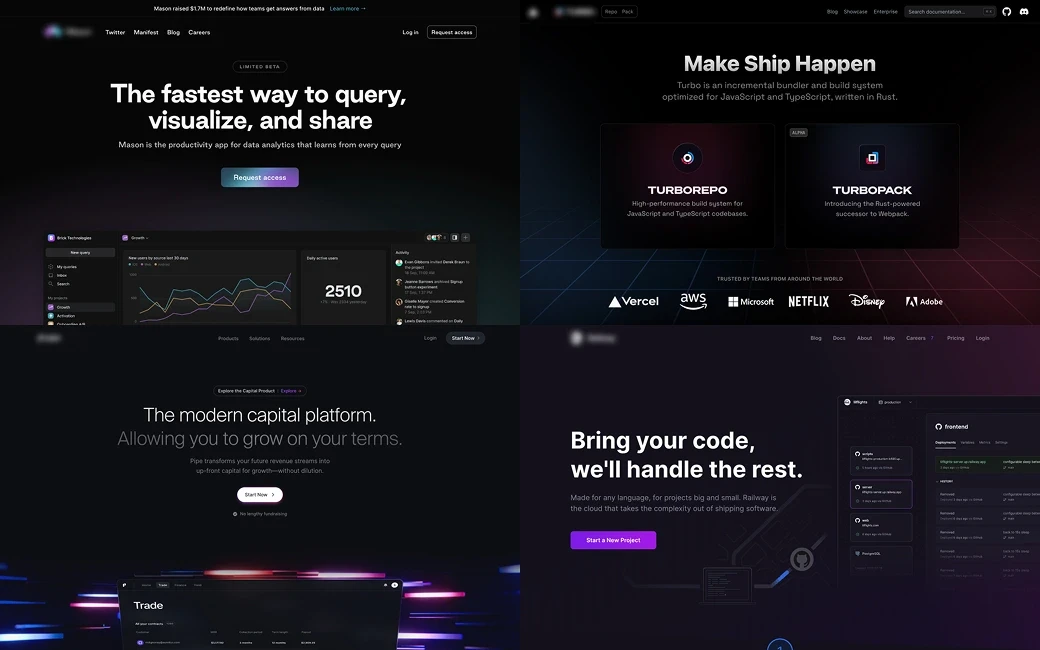
Visual design moves in cycles. One aesthetic dominates, then the market overcorrects.
A few years ago, every SaaS product seemed to have gradient backgrounds, 3D illustrations, and blurple color palettes. Before that, we had Corporate Memphis. Now we're seeing a push toward minimalism, dark modes, and monochromatic palettes.
Here's how these cycles happen: A product like Linear takes off. Teams in adjacent spaces put it on their inspiration boards. They show up to their brand kickoff saying some version of: "We want to look like this."
So they copy the dark UI, the cool grayscale, the minimal interface—but not the thinking underneath it. And then we end up with a wall of SaaS websites that look exactly the same.
The mistake? Believing that aesthetics caused the success.
Linear's brand didn't succeed because it was dark mode. Linear's brand succeeded because every visual decision reinforced a product strategy, a category opportunity, and the emotion they wanted their target audience—engineers—to feel.
Linear's visual identity was product strategy in disguise
Before Linear, the project management category lived on two ends of a spectrum.
On one side: Jira—infinitely customizable, process-heavy, enterprise-first.
On the other: "fun productivity tools" like Asana with colorful illustrations, friendly UI, and approachable vibes.
Both made sense for their time.
But Linear's co-founder Karri Saarinen saw something no one was addressing: engineers weren't asking for cute. They weren't looking for another cheerful dashboard and rainbow narwhal. They wanted tools that respected their craft.
His insight:
"If I'm building a house, I don't want my tools to be fun. I want them to be good."
So Linear designed itself to feel like a precision instrument.
The strategic choices behind the aesthetic
Everything followed from that positioning decision:
Dark mode as the default
Not because it looked cool, but because it matched the coding environments engineers already live in. It signals: we're built for you.
Inter in dark gray on black
Professional, restrained, intentionally un-playful. It echoes the Mac Pro design language engineers already associate with craftsmanship.
Opinionated UI with minimal customization
A direct counterposition to Jira. Constraints as a feature. Flow over flexibility.
Speed as design
Every detail oriented around preserving momentum. Nothing should break flow.
This wasn't aesthetics. It was an emotional outcome: pride, calm, focus, no friction. Tools that disappear so you can get into deep work.
That's the power of a strategic identity: it's not decoration—it's clarity.
Your visual identity should make your positioning visible. When it works, prospects feel it before they read a single word of copy. When it doesn't, you're just contributing to the aesthetic noise of your category.
A strategic visual identity doesn't start with an inspiration board. It starts with strategy.
What is your product strategy?
Linear's was highly opinionated, crafted for flow. Jira's was flexible, customizable, enterprise control. Both valid—but they require opposite identities.
What emotional space is unclaimed in your category?
Linear moved into "serious, calm, precision-focused" when everyone else was trying to be cheerful. Where's the opening for you?
What specific feelings should your product evoke?
Not "delight"—that's vague. Name them: clarity, momentum, trust, confidence, relief, mastery. Your visuals should reinforce those.
Who are you not for?
Your identity becomes stronger the moment you draw the line.
If your visual identity could be swapped onto a competitor's homepage and still make sense, it's not differentiating your product—it's wallpaper.
Every startup wants the Linear aesthetic without the Linear strategy. Every founder wants the Notion look without the Notion systems thinking.
But those companies don't look the way they do because it's trendy. They look the way they do because their visual identities are extensions of product strategy and emotional intent. And yes, also good design.
The goal isn't to copy what winners look like. The goal is to do what they did: Find your unique insight, decide the emotion you want your product to create, and design your visual identity as the clearest expression of both.
That's how you build a brand that actually means something—not one that just looks like something.